I remember exactly where I was when I first read Gunther Eysenbach’s paper on apomediation. It wasn’t a clinical trial, it wasn’t a guideline — it was a description of something that had already happened to my profession without anyone asking permission. The internet, Eysenbach argued, was no longer simply intermediating access to health information the way a librarian or a filing cabinet might. It was doing something more disruptive: it was letting patients bypass the traditional intermediary altogether, drawing instead on the collective intelligence of peers, communities, and algorithms to find, filter, and validate information for themselves [1]. He called this apomediation — literally, mediation from beside rather than from above.
For a physician trained to believe that interpreting and transmitting medical knowledge was one of the core, almost sacred functions of the job, this was unsettling in the best possible way. My patients were no longer waiting for me to hand them information. Many of them arrived already holding it, sometimes more current than what I’d learned in school, occasionally wrong, but always theirs. The exclusive role I thought I had was already gone. The only real question left was what I was going to do about it.
It takes (at least) two to tango
The shared decision-making movement was building in parallel, and for good reason — it gave a name and a structure to what apomediation had made unavoidable. Charles, Gafni, and Whelan’s foundational 1997 paper put it in a phrase that has outlived nearly everything else written on the topic: shared decision-making, they wrote, “takes at least two to tango” [2].
Two years later, the BMJ made the point unmissable without a single graph. Its 18 September 1999 issue — No. 7212 — ran a full black-and-white photograph of two dancers locked in a tango across the entire cover, under a single cover line: “Embracing patient partnership.” The issue’s front matter introduced it with a short piece titled, fittingly, “Take your partners for the dance” [3], alongside Charles, Whelan, and Gafni’s own paper in that same issue asking what partnership in treatment decisions actually means [4]. Twenty-six years later, I still think it’s one of the best covers a medical journal has ever run — it made the argument in one image that a hundred editorials couldn’t.
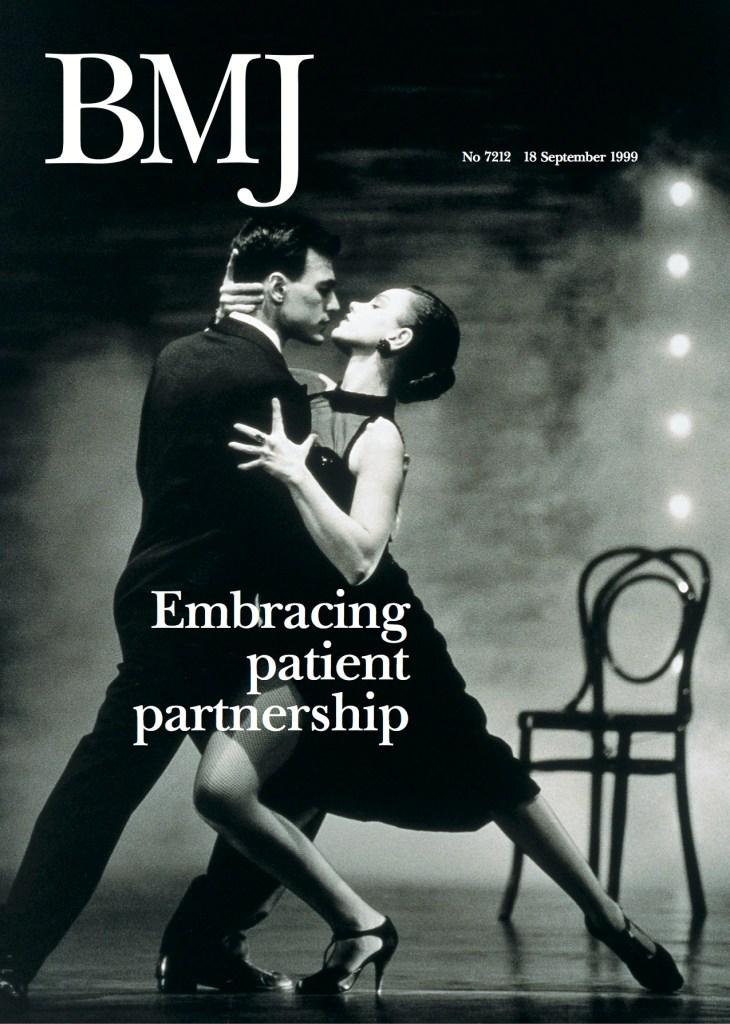
The metaphor held up because it insisted on something uncomfortable for a paternalistic profession — that a good outcome depends on both partners moving, listening, and adjusting to each other, not on one partner leading and the other following.
What the evidence actually shows
It would be easy for “shared decision-making” to have remained a nice idea with no teeth. It hasn’t. The most recent update of the Cochrane review of patient decision aids — 209 trials, over 107,000 participants — found high-certainty evidence that decision aids improve patients’ knowledge, sharpen the accuracy of their risk perceptions, and reduce decisional conflict tied to feeling uninformed or unclear about their own values, while also reducing the proportion of patients left in a purely passive, clinician-controlled role [5]. Reassuringly, none of this comes at the cost of more regret about the choices made, and it barely adds to consultation time.
A 2024 umbrella review pulling together 48 systematic reviews of shared decision-making more broadly reached a similarly grounded conclusion: benefits for outcomes and quality of care that range from neutral to positive depending on the population, achieved without reliably increasing cost or consultation length [6]. In other words, this is not a movement running on good intentions. It is one of the few areas of clinical communication where the evidence base has actually caught up with the rhetoric.
The paternalism we still teach
And yet — this is where it gets hard, and where I have to include myself and my own training in the criticism — we are still not systematically taught how to do any of this. Medical education remains, structurally, a Flexnerian institution. Abraham Flexner’s 1910 report is rightly credited with cleaning up a chaotic, often dangerous system of medical schools, but a recent history of the century since notes that in doing so it also entrenched a rigid, biomedical, university-based model that — in the authors’ words — “inadvertently created rigid departmental silos,” an architecture medical education has spent decades since trying to dismantle in favor of more integrated, problem-based learning [7].
Those silos didn’t just separate anatomy from physiology. They quietly ranked the curriculum, and the ranking has outlived every reform that claimed to fix it. Who, today, is actually teaching medical anthropology, medical sociology, or the humanities with the same rigor and protected curricular time as pharmacology? There is no shortage of stated “interest” in these fields at every education conference I’ve attended. But interest is cheap. Faculty time, assessment weight, and promotion criteria are not, and those are still overwhelmingly allocated to what gets called — tellingly — the “hard skills,” while the skills that actually make shared decision-making possible get filed under “soft,” optional, and someone else’s job.
Designing for the human part
The digital revolution now underway will not reverse this on its own — if anything, left unmanaged, it could simply automate the paternalism, replacing one authoritative voice with another that patients are even less equipped to question. But it also hands us the clearest mandate we have had in a generation to finally do the harder work: identify, explicitly, what the irreducibly human part of this job actually is; design curricula around it with the same seriousness we bring to a nephrology rotation; test which teaching strategies actually build the capacity to negotiate a decision rather than dictate one; measure the impact on learning outcomes with the same rigor as any other educational intervention; and disseminate what works instead of letting it die as a single enthusiastic professor’s innovative project, confined to one classroom and one career.
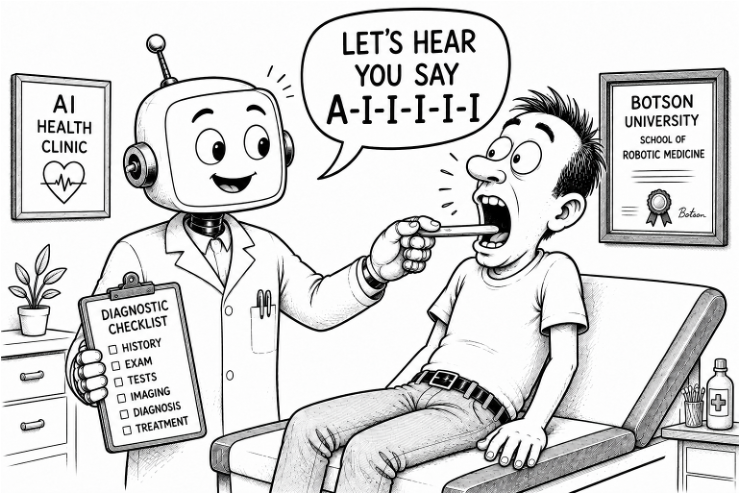
If we don’t do that work, the alternative isn’t neutral. It’s a waiting room where the sign eventually reads: take your seat, Doctor Robot will be calling you in a minute. Apomediation already told us, twenty years ago, that patients don’t need a gatekeeper. What they still need — what we have not yet taught ourselves to reliably provide — is a partner who knows how to dance.
This essay grew out of a talk I gave jointly with a patient-partner at the SGAIM/SSMIG Autumn Congress 2026 (“D’égal à égal – La médecine en dialogue”), and draws on my own path through this question — as a physician in training, as a trainer in the role of chief resident, and now as a medical educator.
References
- Eysenbach G. Medicine 2.0: Social Networking, Collaboration, Participation, Apomediation, and Openness. J Med Internet Res. 2008;10(3):e22. Available from: https://www.jmir.org/2008/3/e22/
- Charles C, Gafni A, Whelan T. Shared decision-making in the medical encounter: what does it mean? (or, it takes at least two to tango). Soc Sci Med. 1997;44(5):681-692. Available from: https://pubmed.ncbi.nlm.nih.gov/9032835/
- Take your partners for the dance [editorial]. BMJ. 1999;319(7212):A. Available from: https://pubmed.ncbi.nlm.nih.gov/10488043/
- Charles C, Whelan T, Gafni A. What do we mean by partnership in making decisions about treatment? BMJ. 1999;319(7212):780-782. Available from: https://pubmed.ncbi.nlm.nih.gov/10488014/
- Stacey D, Lewis KB, Smith M, et al. Decision aids for people facing health treatment or screening decisions. Cochrane Database Syst Rev. 2024;1(1):CD001431. Available from: https://pubmed.ncbi.nlm.nih.gov/38284415/
- Bruch JD, Khazen M, Mahmic-Kaknjo M, Légaré F, Ellen ME. The effects of shared decision making on health outcomes, health care quality, cost, and consultation time: An umbrella review. Patient Educ Couns. 2024;129:108408. Available from: https://pubmed.ncbi.nlm.nih.gov/39214045/
- Munnur R, Chapala S, Gibson J, Cheraya G, Iyengar KP, Botchu R. From Flexner to artificial intelligence: a century of transformation in global medical education. Postgrad Med J. 2026. Available from: https://academic.oup.com/pmj/advance-article/doi/10.1093/postmj/qgag067/8698112
 Alexandre Gouveia